
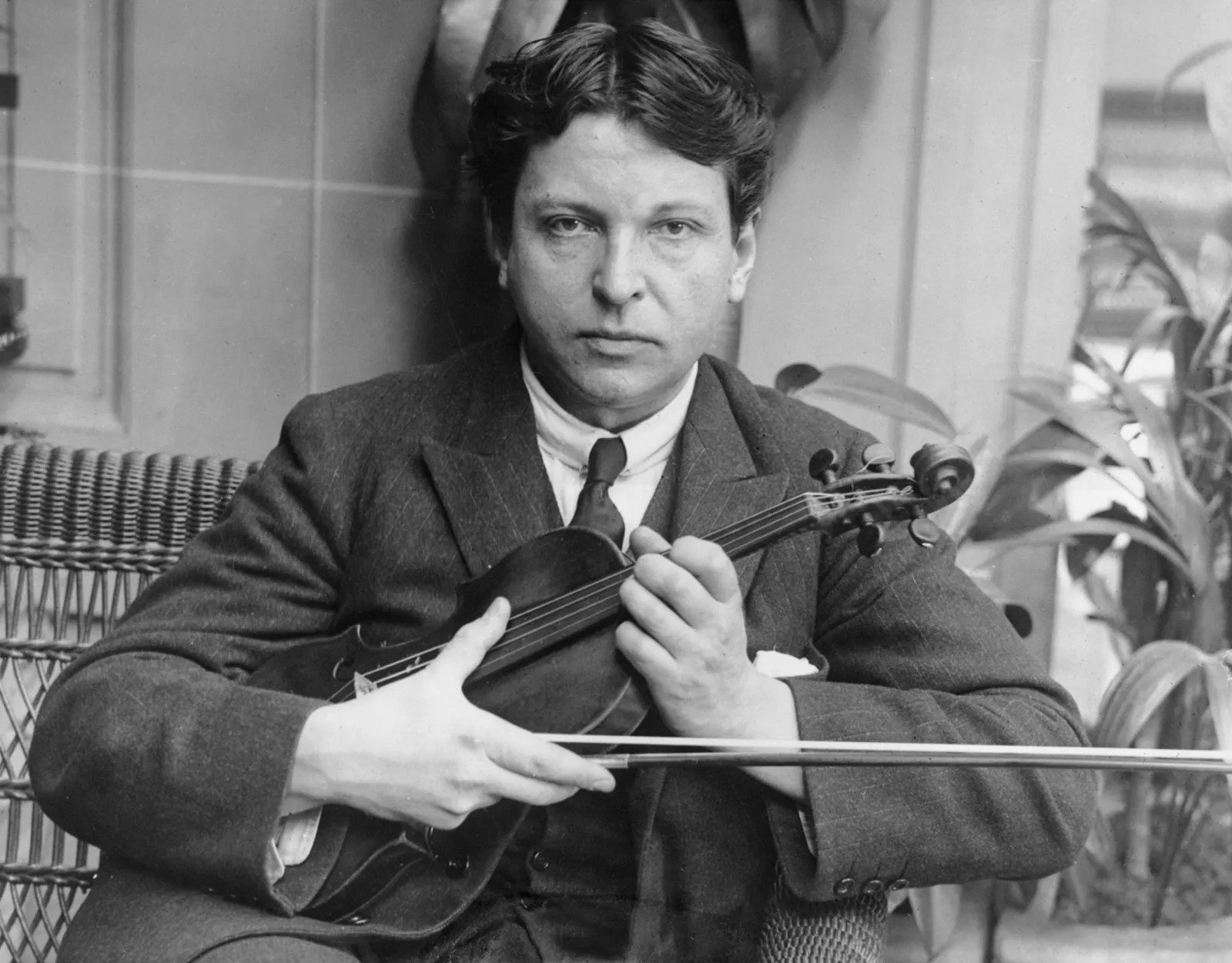
George Enescu: A Life Dedicated to Music
George Enescu (born August 19, 1881, in Liveni, Botoșani – died May 4, 1955, in Paris) is recognized as the most important Romanian musician. His artistic talent manifested in various fields: composer, violinist, pedagogue, pianist, and conductor.
Enescu began studying the violin at the age of 4, guided by his parents and the fiddler Niculae Chioru. At just 5-6 years old, he made his first attempts at composition. His early musical education started with professor Eduard Caudella.
Studies in Vienna and Paris
From 1888 to 1894, Enescu studied at the Vienna Conservatory, mentored by Joseph Hellmesberger jr. (violin) and Robert Fuchs (composition). At 8 years old, he debuted as a violinist, being called “a Romanian Mozart” by the Viennese press.
After Vienna, Enescu continued his studies at the Paris Conservatory (1895-1899), guided by Martin Pierre Marsick (violin), André Gédalge (counterpoint), Jules Massenet, and Gabriel Fauré (composition). Among his colleagues were Maurice Ravel, Florent Schmitt, Charles Koechlin, and Theodor Fuchs.
Early Career and Compositional Debut
Enescu made his compositional debut on February 6, 1898, at the Colonne Concerts in Paris with Poema Română, op. 1, thanks to the support of Elena Bibescu. In the same year, at 17, he began teaching violin and giving recitals in Bucharest, often invited to perform at Peleș Castle in Sinaia by Queen Elisabeth of Romania, known as Carmen Sylva.
Some of his most well-known works from the early 20th century include the two Romanian Rhapsodies, op. 11 (1901-1902), Suite No. 1 for Orchestra, op. 9 (1903), his First Symphony in E-flat, op. 13 (1905), and Seven Songs on Verses by Clément Marot, op. 15 (1908).
Professional Activity
Enescu had an intense career both in Bucharest and Paris, participating in tours across many European countries alongside renowned partners such as Alfredo Casella, Pablo Casals, and Louis Fournier. During World War I, he stayed in Bucharest, conducting works by Beethoven, Berlioz, Debussy, Wagner, and his own creations. In 1913, he founded the National Composition Contest to encourage Romanian musical creation.
Later Years and Final Works
After the war, Enescu continued his tours in Europe and the United States, conducting prestigious orchestras. His pedagogical activities were significant, teaching renowned students like Christian Ferras, Ivry Gitlis, Arthur Grumiaux, and Yehudi Menuhin, who considered Enescu “one of the true wonders of the world.”
In 1936, the premiere of his opera “Oedip” took place in Paris, receiving great acclaim. During World War II, he remained in Bucharest, encouraging Romanian composers and conducting intensively.
In 1946, Enescu went on a tour in the USSR and later in the United States, settling in Paris in protest against the communist regime in Romania. Among his final works are the String Quartet No. 2, op. 22, the symphonic poem Vox Maris, op. 31, and the Chamber Symphony, op. 33.
George Enescu passed away on the night of May 3-4, 1955, and is buried at Père Lachaise Cemetery in Paris.